THE Gold Trading Alert - Major Changes
Oct. 14, 2025
Briefly: in our opinion, speculative short positions in GDXJ, NEM, and FCX (more advanced traders might consider purchasing put options) are justified from the risk to reward point of view at the moment of publishing this Alert.
I’m adding a short position in silver through silver put options, and I’m adjusting / hedging the INVESTMENT position in silver (taking profits in it) and in the INSURANCE capital (taking profits from half thereof).
===
In three points:
Silver just invalidated the move above its previous high and above the $50 level. It came back above $50, but this doesn’t change the fact that those invalidations are strong sell signals.
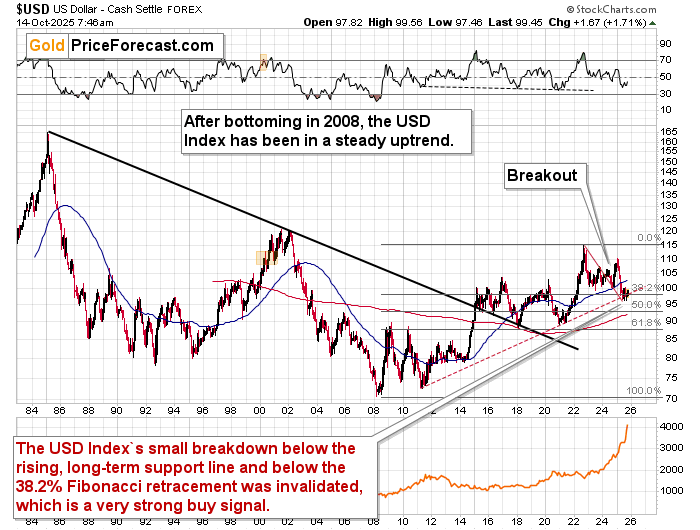
The USD Index’s outlook is extremely bullish here amid the extremely bearish sentiment.
Miners’ only moved to their previous highs despite a move to new highs in gold and silver – which is a classic topping sign.
===
THE – because it was never before that I made adjustments to the insurance capital of the portfolio – until today.
In short, it’s quite possible that the speculative bubble just popped, and that we saw the final top in the overnight trading.
The technical picture in silver is the clearest one, and the link to 2011 is so clear that it almost hurts.
Here’s what we have right now:
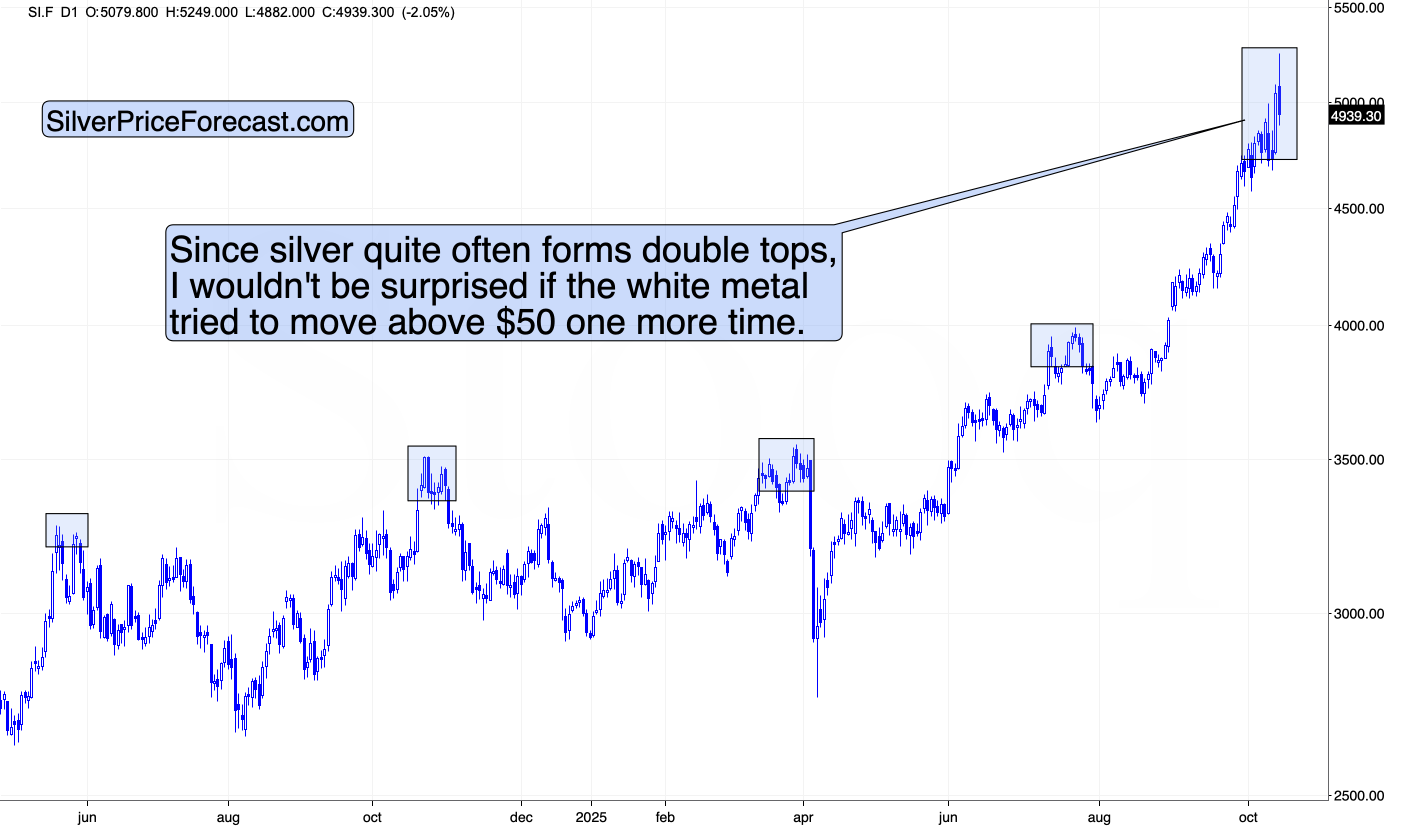
Silver futures just soared to $52.49, and they reversed in a way that was truly extreme.
I woke up, checked prices – silver was up $1.5. I took a shower and checked again – it was up only $0.5. I prepared a cup of tea and sat down for work. When I opened my computer, silver was already down $0.5. I quickly looked at the charts, and before I was done with this initial overview, silver futures dropped below $50.
So far, this behavior has all the characteristics of a major top in silver – and in consequence, most likely also in gold and miners.
To clarify: silver futures moved below $49 and as I’m typing this, silver futures are trading at $50.22 and gold futures are trading at $4,147.
It gets even better/worse (depending on how you look at it) and much clearer, when you consider how silver topped previously. I’ve been writing about silver’s tendency to form double tops for a few days now, so yesterday’s and today’s overnight rallies should not be a surprise to you. I had emphasized that we were likely to see a top this or the next week, and while we could still have another attempt to move higher or just match the recent highs… Given how previous parabolas in silver ended (the volatile nature of today’s slide is another confirmation), the odds are that this is IT.
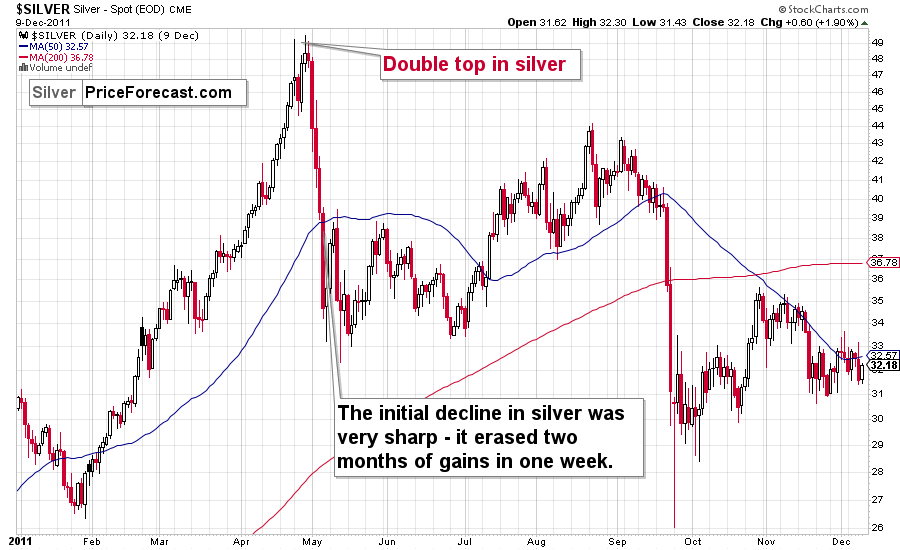
Back in 2011, the final top formed precisely three trading days after the initial reversal.
Today is the third day after the reversal.
The final confirmation came from silver’s invalidation of the move above the first high. If you track silvers rally, this is something that did not happen previously – all the previous declines ended above or at the previous tops (even the mid-March exception was tiny).
All this is what makes today’s invalidation so profound from the technical point of view.
The indications coming from “outside of the chart world” confirm the above as well. Quoting my yesterday’s reply to EJ:
“I’m not sure if I’ll want to short silver at all unless it clearly invalidates the breakout above the previous highs. Actually, it seems to me that buying PUTs for silver might be the best way to play this as in this case of the silver take-off, we wouldn’t be exposed to a big risk - just the loss of the premium. Either way, I’d wait until the $51-$52 area. Most importantly, though, given the analogies to 2008 and 2011, it seems that not enough time passed since the first top. Silver is making headlines today, which could give it a final push for a few more days.”

Those headlines seem to have worked faster than expected. Everyone got in quickly and that likely tipped the scales.
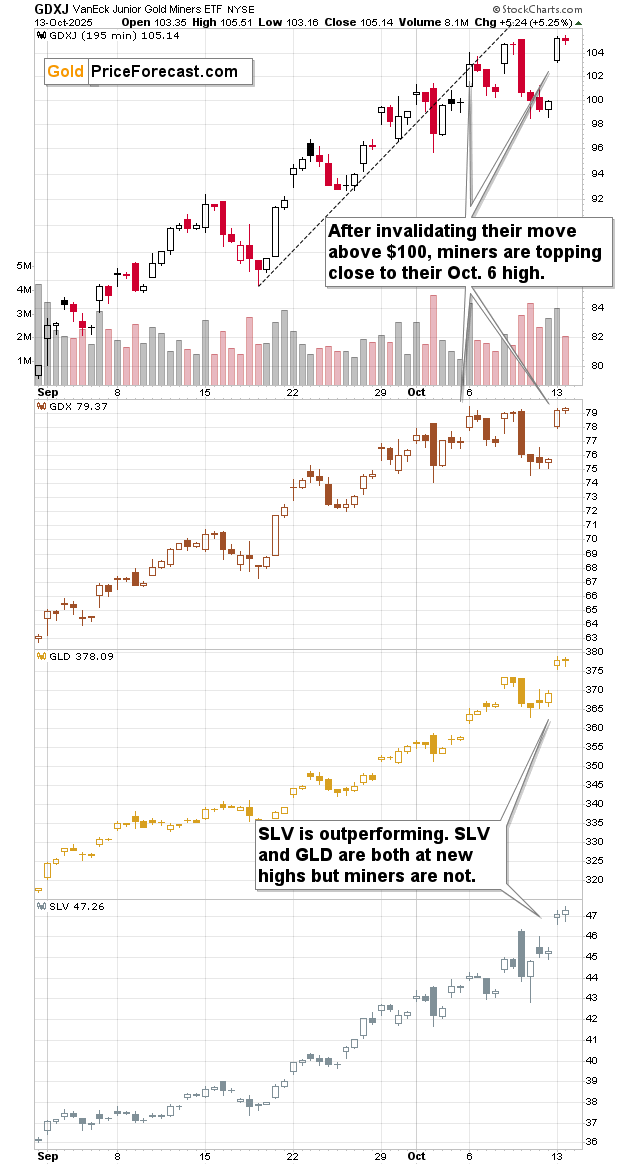
Despite silver’s yesterday’s rally and despite the one in gold – and breakouts to new highs in both: mining stocks did not move to new highs. Again, that’s what often characterizes tops.
Also, have you noticed how the USD simply does no longer care about the bearish news? Tariffs this, tariffs that, Fed this, Fed that… And the USD Index refuses to decline.
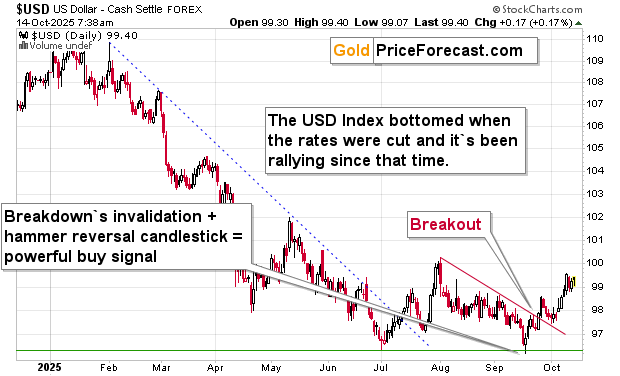
Ever since the rates were cut, the USD Index has been on the rise. I’d been preparing you for this for some time, emphasizing the “buy-the-rumor-sell-the-fact” type of reaction (in this particular case, it’s sell-the-rumor-buy-the-fact as it’s about a bullish turnaround), so USD’s reversal and a rally despite declining rates was not surprising to you.
What happened later continued to be rather negative news for the USD, but the latter didn’t care as it had already priced in the maximum chaos, and the sentiment had already been extremely negative.
Being bullish on the USD Index right now is “buying when there’s blood on the streets”.
Would you like to get back in time and buy everything at the 2020 bottom (just like we did with miners back then)? This is your chance, but on a different market. Back in 2020, stocks and other markets were shunned because everyone panicked. Right now, the USD Index is shunned despite it being the world reserve currency (not to the extent that it used to be, but still!), and despite the U.S. military and economic power.
And despite its long-term uptrend.
Are there multiple problems with the USD itself? Sure.
But is the situation really better in the Japan or Eurozone? Because that’s what USD Index bears are essentially saying. The two biggest components of the USD Index are the EUR/USD and YEN/USD exchange rates.
No – things are not better in the Eurozone and in Japan than they are in the U.S., and many things are going better in the U.S. – for example taking advantage of the AI revolution. There are only two major players on the AI scene – U.S. and China.
Are people losing trust in the fiat currencies in general? I think so, but this doesn’t mean that the fiat currencies are going to be destroyed overnight. Before this happens, things will probably need to get really bad on the markets (think 2020 or 2008 but more severe), so that people then accept the “solution” to it in the form of something that benefits the governments (CBDCs = gov’t cryptos for example).
While precious metals would be a great protection about all this in general, let’s keep in mind that during the early stage of the slide, they decline (severely so) along with stocks and other assets while the USD soars. Miners and silver are hit particularly hard. Same with copper (and FCX).
PMs recover faster than other markets, but they still decline with everything else first.
I think that this is where we’re heading.
USD Index’s resilience suggests that the rally in it is likely to continue shortly. And when the latter becomes more visible, PMs tend to react. Given what they are doing right now and how extremely overbought they are, they are very vulnerable to a sharp sell-off.
Silver’s move back below $50 in the overnight trading suggests that the tipping point may have been reached.
The final thing that I’d like to add is that if we see a move higher in silver once again today or tomorrow, it will be perfectly normal in light of what we saw in 2011. After the invalidation of its breakout and forming its final top, silver moved higher one last time before truly sliding and erasing two months of gains in a week.
All right, so what do we do with all this information?
We already have short positions in mining stocks, so we’re prepared to take advantage of the decline on the trading front. I’m adding a speculative short position in silver, but only through put options, as I don’t want to be exposed to unlimited risk just in case silver does take off this time without declining first.
However, given the severity of the situation from the medium-term point of view, I think that further adjustments are warranted.
By this, I mean the following:
Taking profits from half of the holdings in the insurance part of the capital.
Exiting or hedging the long-term investment part in silver – if possible.
In case of the latter, if you participate in the silver bond offer, the odds are that you can’t get out of this arrangement right now, due to its long-term nature, but if you simply bought silver instead of the silver bond (or silver-related assets), I think that taking profits off the table and exiting them now is justified from the risk to reward point of view.
The first point might seem shocking to you, and it wouldn’t be surprising. Ever since I wrote about the insurance capital and being invested in it well over a decade ago, I never exited those positions.
That article was posted on Sep. 19, 2012. Back then, gold was trading at about $1,770, and silver was trading at about $34.5.
It was never the case, since that time, that I wrote about exiting or limiting the size of the insurance capital. Despite periods where I’ve been bullish, I didn’t increase this position, and despite the periods where I’ve been bearish, I never decreased this position. This is exactly that – insurance against systemic risk, but also against the risk of me being wrong on the short- and medium-term moves in the precious metals market.
This is what being realistic – and prepared – means. Making sure that you’re covered even if you’re wrong.
Sadly, many people – even my subscribers – completely ignored this part of my analysis (each type of capital including insurance capital has been featured in all Gold Trading Alerts along with a link with explanations) and thought that I’ve been completely “against” the precious metals market instead of viewing my service in its entirety.
Anyway, given what we see on the markets right now, and how critical the situation is, I think that making adjustment even in this type of capital is now justified from the risk to reward point of view.
Of course, I don’t mean getting rid of the insurance capital entirely, but I do mean taking profits on half of those positions.
Since – unlike the size of the trading positions – the weight of those positions was significant (based on the above-linked report) it was 44.1% (Eric – the beginner investor), 33.6% (prof. Jill – the long-term investor), and 17.6% (John – the trader), taking profits on half of them has big implications on the portfolio and the profits taken here are likely significant.
Now, if you can’t exit the insurance capital (liquidity constraints etc.), it might be a good idea to consider hedging it.
Buying put options might be particularly useful in my view, as that provides a time-limit on the hedge – if we’re wrong and the markets continue to soar, the option will simply expire and only the premium paid for the option will be lost, while the core positions will gain.
The size of the hedge is up to you – if you decide to hedge your investments AND insurance then the size will be bigger than if you decide to hedge just the investments.
I’m providing details regarding this in the Summary section below, and for now, I’d like to quote what I ended yesterday’s Gold Trading Alert with:
In my view, this is the period when it’s dollars to the upside and tens of dollars to the downside in case of the GDXJ. For those that don’t have a short position in the GDXJ or their short position is not as big as they would like it to be, this day might be viewed as a great opportunity to enter or add to those positions.
As always, I’ll keep you – my subscribers – informed.
Thank you.
Overview of the Upcoming Part of the Decline
The more detailed “overview of the upcoming part of the decline” will be back (and updated) once it’s obvious that the top in gold is indeed in, and it’s after the initial significant decline. Gold’s top (the same goes for miners’ top) price level is one of the things that I’m basing my downside targets on, and while at this point it IS likely that gold topped, I’d like to see a bigger slide before stating what kind of (more specific) scenario going forward is most likely.
Please note that the chart below features the most likely downside target area in my view (from the medium-term point of view), while the downside target featured in the “Trading” part of the summary features the downside target for the trading position. The latter is likely to be reached earlier; then, we might see a correction and then further declines.
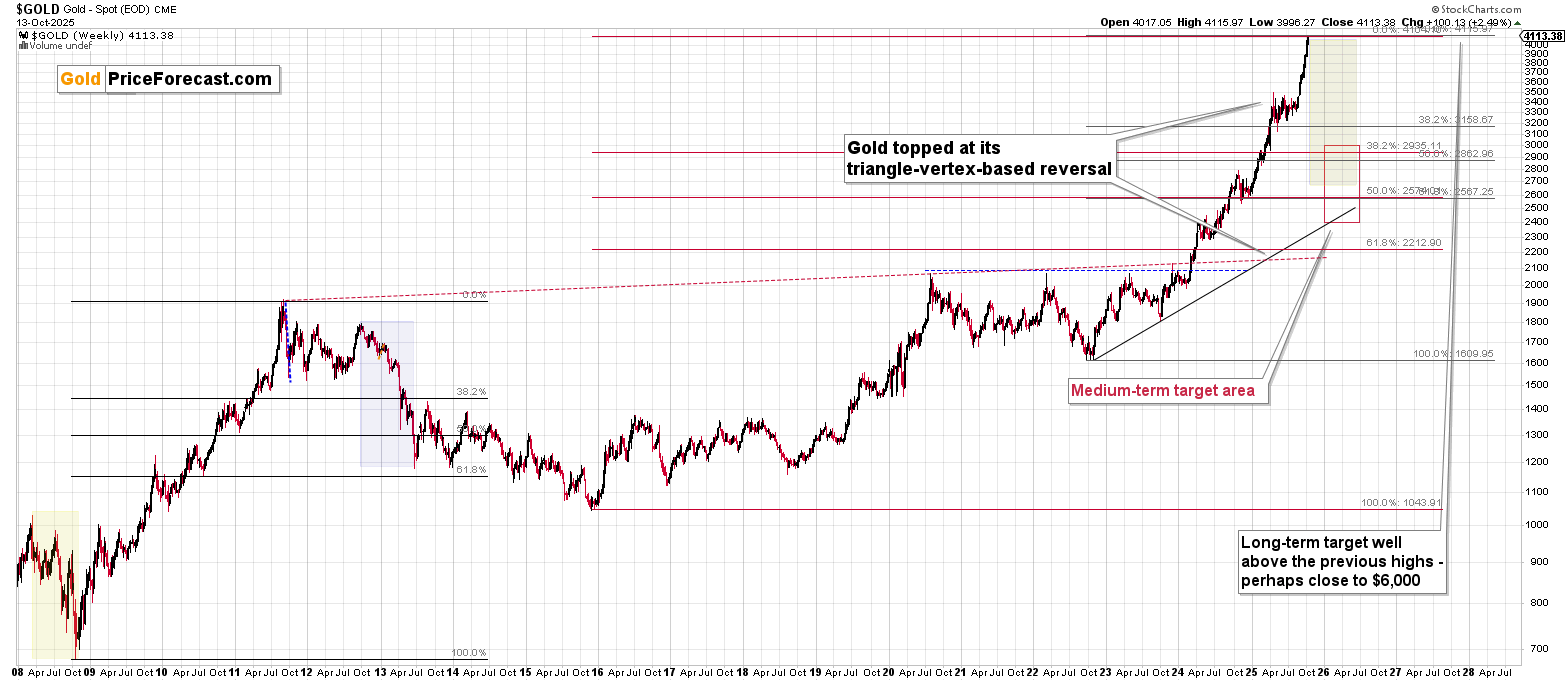
Please note that the above timing details are relatively broad and “for general overview only” – so that you know more or less what I think and how volatile I think the moves are likely to be – on an approximate basis. These time targets are not binding nor clear enough for me to think that they should be used for purchasing options, warrants, or similar instruments.
Letters to the Editor
For support enquiries, please contact the Golden Meadow® support – they will be happy to help. In particular, please contact support if you plan to upgrade your subscription to the Diamond Package – the team will make sure that all your paid-for days get properly transferred.
Summary
To summarize, it seems that gold’s final top for 2025 is in or about to be in, and the same goes for silver and mining stocks. Conversely, it seems that the USD Index just formed its yearly bottom.
As always, I will keep you – my subscribers – updated.
Thank you for being part of this journey.
///
To summarize:
Trading capital (supplementary part of the portfolio; our opinion): The following speculative positions are justified from the risk to reward point of view with the following binding exit profit-take price levels:
Shorting silver through short-term put options on SLV ETF: strike price $45, expiration: Nov. 7, 2025
Short-term downside target for silver: $36 - $40 – I’ll be more precise when the decline accelerates. That’s $32.5 - $36.5 in the SLV ETF.
===
Shorting mining stocks (price levels for the GDXJ ETF): binding profit-take level: $65.52; stop-loss: none.
New approach - shorting the leveraged GDXJ-based instrument: the JNUG: binding profit-take level: $72.63, stop-loss: none.
Alternatively, if one seeks leverage, we’re providing the binding profit-take levels for the JDST (2x leveraged). The binding profit-take level for the JDST: $9.77; stop-loss for the JDST: none
===
Short position in the FCX with $24.32 as the profit-take level.
New option plays for FCX: FCX option November, 21, 2025 PUT options with $40 strike price.
===
Short position in the NEM with $56.12 as the profit-take level.
===
For-your-information targets (our opinion; we continue to think that mining stocks are the preferred way of taking advantage of the upcoming price move, but if for whatever reason one wants / has to use gold / silver for this trade, we are providing the details anyway.):
Gold futures downside target: $2,922
Silver futures downside target: $28.11
GLD binding downside target: $263.97
GLL binding downside target: $14.64
SLV binding downside target: $25.12
ZSL binding downside target: $41.78
AGQ binding downside target: $27.78
GDXU.TO - Canadian ETF (preferred approach: shorting a 2x leveraged long ETF for mining stocks): binding profit-take exit price: $40.12 (stop-loss: none)
GDXD.TO - Canadian ETF (alternative approach: going long a 2x leveraged inverse ETF for mining stocks)– the binding profit-take level: $10.98 (stop-loss: none)
SLVU.TO - Canadian ETF (shorting 2x leveraged silver ETF)– the binding profit-take level: $19.42
SLVD.TO - Canadian ETF (going long 2x inverse leveraged silver ETF)– the binding profit-take level: $8.14
===
Long-term capital (core part of the portfolio; our opinion): cash / cash equivalents (T-bills). In case of a long-term position in silver bonds or other illiquid asset, I think that hedging it is a now justified from the risk to reward point of view. Details below.
Insurance capital (core part of the portfolio; our opinion): Half position. If you’d like to buy gold or silver (for example through your IRA – you get a guidebook on that over here), I suggest that you do so through one of the top gold dealers.
In case of a position in illiquid assets, I think that hedging it is a now justified from the risk to reward point of view. Details:
Gold hedge: Put options for gold with $4,000 as the strike price. Expiration: December 23, 2025
Silver hedge: Put options for silver with $47.50 as the strike price. Expiration: December 23, 2025
===
Mobile app / notifications:
Mobile Alerts are available via an app called Circle:
- iOS Circle download link
- Android Circle download link
Log in with your Golden Meadow username/password and voila - you have Golden Meadow on your mobile. Then you can set up notifications exactly as you want them to be - you can customize this per space (e.g. you might want to get all Gold Trading Alerts notifications on your mobile, but not for what is provided in other spaces). You can also navigate to notifications by clicking on your profile picture in the top right corner of the page and then selecting “notifications”.
===
Please note that we describe the situation for the day that the alert is posted in the trading section. In other words, if we are writing about a speculative position, it means that it is up-to-date on the day it was posted. We are also featuring the initial target prices to decide whether keeping a position on a given day is in tune with your approach (some moves are too small for medium-term traders, and some might appear too big for day-traders).
Please note that a full position doesn't mean using all of the capital for a given trade. You will find details on our thoughts on gold portfolio structuring in the linked essay.
As a reminder - "initial target price" means exactly that - an "initial" one. It's not a price level at which we suggest closing positions. If this becomes the case (as it did in the previous trade), we will refer to these levels as levels of exit orders (exactly as we've done previously). Stop-loss levels, however, are naturally not "initial", but something that, in our opinion, might be entered as an order.
Since it is impossible to synchronize target prices and stop-loss levels for all the ETFs and ETNs with the main markets that we provide these levels for (gold, silver and mining stocks - the GDX ETF), the stop-loss levels and target prices for other ETNs and ETF (among other: UGL, GLL, AGQ, ZSL, NUGT, DUST, JNUG, JDST) are provided as supplementary, and not as "final". This means that if a stop-loss or a target level is reached for any of the "additional instruments" (GLL for instance), but not for the "main instrument" (gold in this case), we will view positions in both gold and GLL as still open and the stop-loss for GLL would have to be moved lower. On the other hand, if gold moves to a stop-loss level but GLL doesn't, then we will view both positions (in gold and GLL) as closed. In other words, since it's not possible to be 100% certain that each related instrument moves to a given level when the underlying instrument does, we can't provide levels that would be binding. The levels that we do provide are our best estimate of the levels that will correspond to the levels in the underlying assets, but it will be the underlying assets that one will need to focus on regarding the signs pointing to closing a given position or keeping it open. We might adjust the levels in the "additional instruments" without adjusting the levels in the "main instruments", which will simply mean that we have improved our estimation of these levels, not that we changed our outlook on the markets. We are already working on a tool that would update these levels daily for the most popular ETFs, ETNs and individual mining stocks.
As a reminder, Gold & Silver Trading Alerts are posted before or on each trading day (we usually post them before the opening bell, but we don't promise doing that each day). If there's anything urgent, we will send you an additional small alert before posting the main one.
Thank you.
Przemyslaw K. Radomski, CFA
Founder, Editor-in-chief